



April 10, 2013
0 comments


Following a very good article by Bastamag on GMO cotton cultivation in Burkina Faso, I thought that even if we opt for organic cotton, it may turn out that some choose to buy cotton clothes that may contain traces of GMOs. And that's immediately less fun.
In Burkina Faso, one of the poorest countries on the planet, Monsanto made these farmers believe that GMO cotton would change their lives. But in the end, the cotton is of poor quality, the yields are not great, and insecticides are still used... In short, GMO cotton is not the panacea!
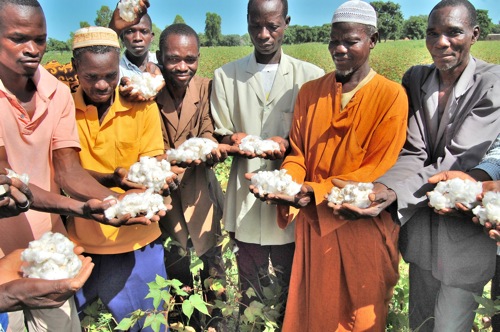 Photo credit Patrick Piro
But we know it, we have seen the Indian disasters of Bt cotton. Which, just as a reminder, led to many suicides of cotton farmers. But if the farmers committed suicide, it was because Bt cotton was not working and too many insecticides had to be used, which led to an even greater cost. Hence debts. Hence loans that the farmers could no longer repay...
The question is, will this happen in the same way in Burkina Faso? Because after all, at the beginning, Monsanto made beautiful promises, but in reality, it's something else entirely.
Of course, GMO cotton is not of better quality for our clothes, and it is probably even worse for our skin because it also needs pesticides...
But the question I ask myself is how to know that our clothes do not contain GMOs. Well, the ideal is, of course, to buy organic clothes, but of course, not everyone buys organic. So when you buy a t-shirt made, for example, in Cambodia or Bangladesh, where does the cotton come from? Because in a garment, there is never any mention of the origin of the material.
Otherwise, read the very good article by Bastamag, you will learn a lot about GMO cultivation in Burkina Faso.
Source You might also like: + Child labor: we talk about it, but do we see it? + Victoria Secret: The other side of ethical lingerieArticle similaire

The end of ultra-fast fashion? A new law that changes the game

Environmental Impact of the Textile Industry: Organic Cotton as a Sustainable Solution

Eczema: Reduce Irritations with Organic Cotton Underwear

Why it is important to produce less


